
The Spiral Design: How Busy Adults Learn Guitar Faster
Nov 16, 2025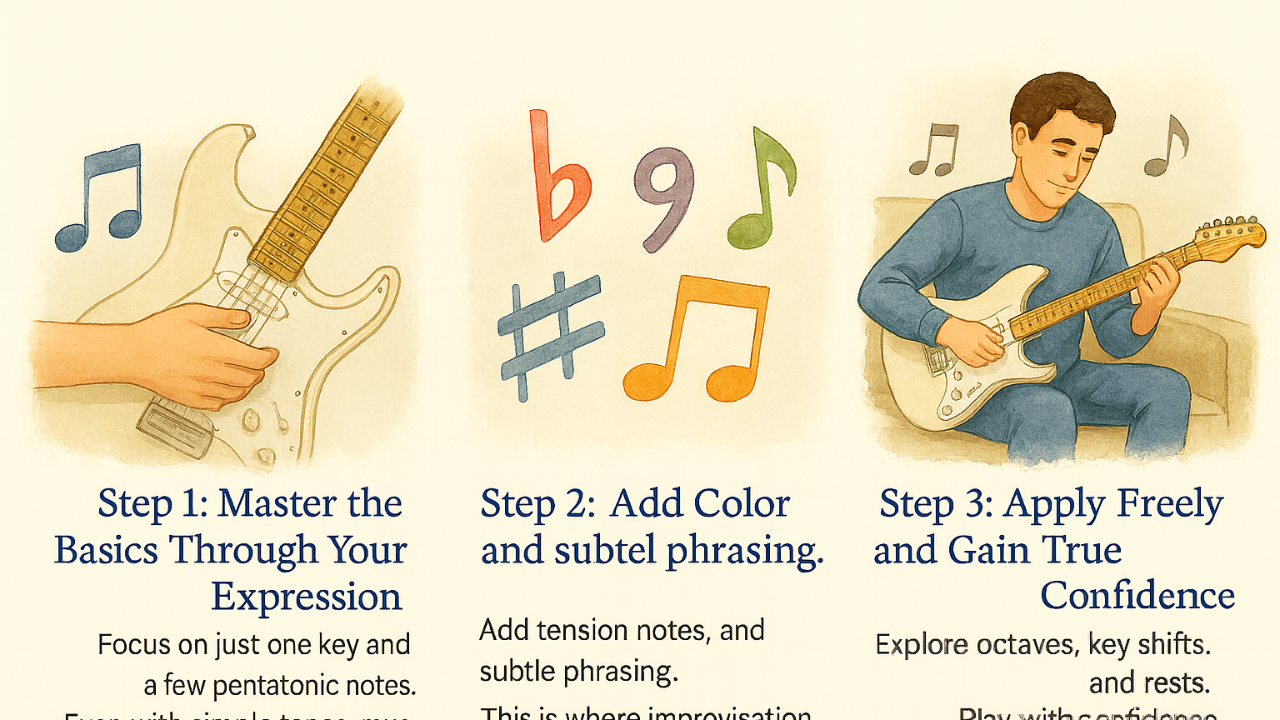
1. Why “More Practice” Isn’t Always the Answer
Many guitar players work hard, yet still feel stuck:
-
You can play songs, but freeze when it’s time to improvise.
-
You study theory, but can’t connect it to your fingers.
-
You practice a lot, but never feel truly “free” on the fretboard.
This isn’t about talent or willpower.
It’s about learning design.
Most lessons follow a linear approach — new material every time, no review, no return.
But the human brain learns best through repetition with variation:
revisiting the same theme in new ways, over time.
In educational psychology, this is called the Spiral Design (or Spiral Curriculum).
2. What Is Spiral Design?
The idea comes from psychologist Jerome Bruner, who proposed that:
“Any subject can be taught effectively in some intellectually honest form to any child at any stage of development.”
His insight was that complex skills become accessible
if the core ideas reappear repeatedly,
each time at a slightly deeper or broader level.
In other words, learning is not a straight line —
it’s a spiral, looping upward.
Easy Jam Life (EJL) applies this educational theory to guitar learning.
Each month revisits familiar ideas — rhythm, phrasing, tone, and harmony —
but in a new context, with just enough challenge to feel fresh.
3. The Spiral in Action: The First 6 Months
Month 1 – One Note Wonder
Discover how a single tone can become music when played with rhythm and space.
This first success removes fear and builds the foundation of musical confidence.
Month 2 – Full Pentatonic
Learn the five-note pentatonic scale that unlocks the entire fretboard.
It’s your basic “vocabulary” for every style of modern improvisation.
Month 3 – Blue Note & 9th Colors
Add the ♭5 (Blue Note) and 9th tones for extra depth and soul.
You’ll feel how one extra note can change the whole emotional world of your solo.
Month 4 – Expressive Tools
Slides, bends, vibrato — the language of touch.
Here, you learn to make your guitar “speak,” not just play correct notes.
Month 5 – Octave Shapes
Shift the same pattern up and down the neck using octaves.
This reveals how the fretboard connects,
and gives you the freedom to play the same idea anywhere.
Month 6 – Across Progressions
Reuse familiar phrases over different chord progressions
(C–F–G–C, Am–F–C–G, FM7–Em7–Dm7–CM7, etc.).
You’ll discover how context changes sound,
turning one lick into a flexible musical language.
4. Why It Works: Cognitive Science Behind EJL
Educational psychology identifies a key mechanism called the Spacing Effect —
information sticks longer when revisited after short intervals.
EJL is built around that principle:
-
Each topic reappears a few weeks or months later, slightly transformed.
-
You encounter it just as you’re about to forget it.
-
That sense of “Oh, I’ve seen this before” locks it into long-term memory.
This way, you don’t force learning —
you grow into it naturally through design.
5. The Later Months: Expression and Freedom
The second half of the program moves beyond notes into expression and interaction.
Without revealing all the details yet, here’s the direction:
-
Month 7 – Silence & Dynamics: Playing with rests, rhythm, and contrast.
-
Month 8 – Dialogue Playing: Responding to backing tracks like a partner.
-
Month 9 – Any Key Freedom: Transferring your ideas to any key.
These months will evolve further as EJL refines its “musical conversation” approach —
always guided by learning science and real-world playability.
6. The “Aha Moment”
The beauty of spiral learning is the moment of connection:
-
A phrase you struggled with months ago suddenly feels effortless.
-
A new chord progression makes sense instantly.
-
Theory transforms into instinct.
These Aha Moments are no accident — they’re built into the structure.
Each return to a familiar idea creates a flash of clarity,
and that feeling is what keeps you motivated.
7. Conclusion: Progress by Design
Most people think improvement comes from practicing harder.
But in truth, progress comes from design.
It’s not about how much you practice,
but how your learning is structured.
EJL’s Spiral Design turns effort into evolution:
-
You revisit ideas instead of abandoning them.
-
You feel constant small wins instead of frustration.
-
You build lasting skills instead of temporary memory.
That’s why even busy adults can learn to improvise freely in just a few minutes a day.
This article is part of the Easy Jam Life archive.
If you want a broader view of how these ideas connect,
you can start from the main hub here:
→Who Easy Jam Life Is For (and Who It Is Not)
Experience how intelligent design can make music feel natural again.
👉https://easyjamlife.mykajabi.com/learn-guitar-improvisation-in-3-minutes-a-day